
Ontario’s regulated iGaming market continues to expand rapidly, with billions in wagers, rising player engagement, and online casinos driving most of the growth.
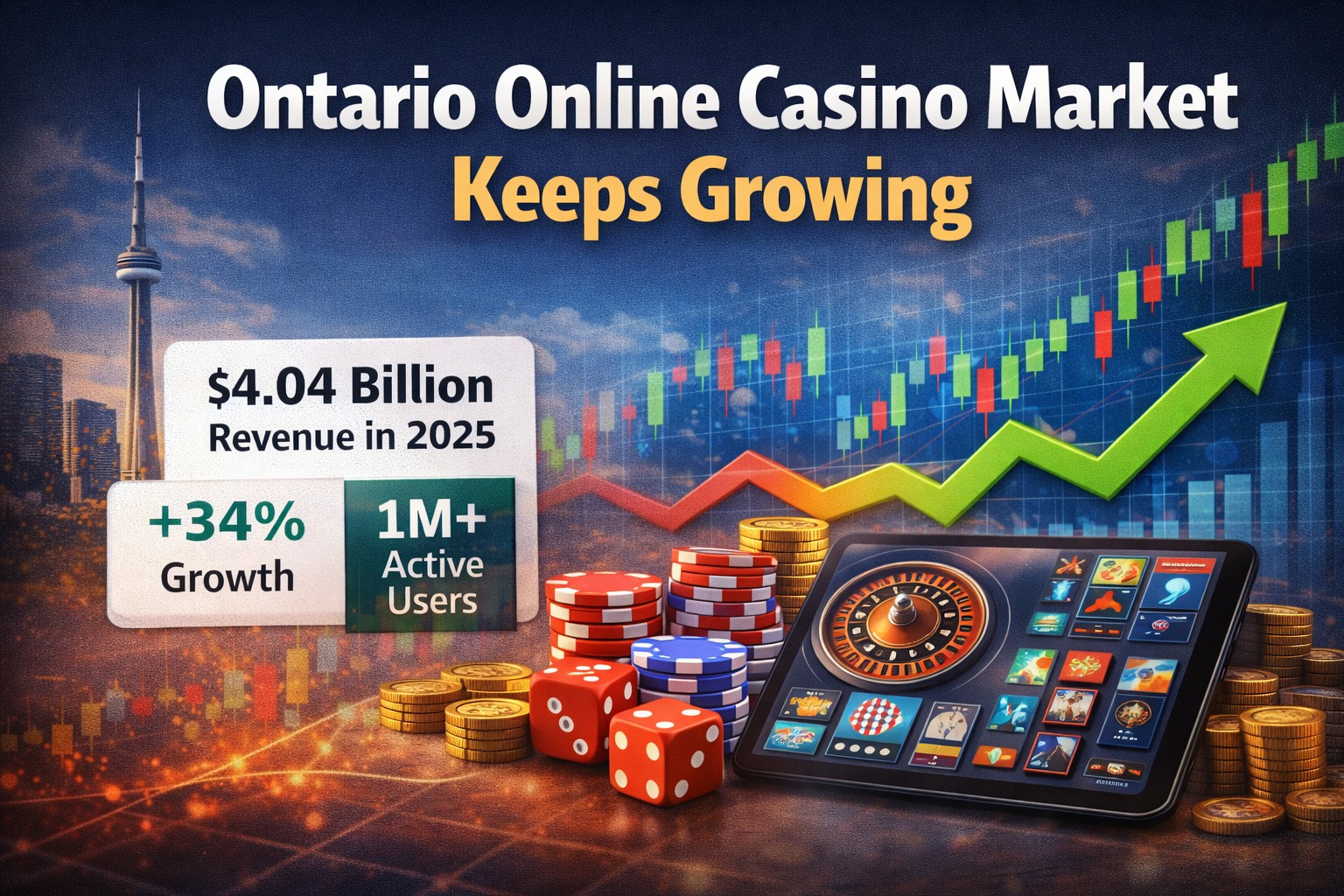
The Ontario market is one of the largest iGaming markets in the Northern Hemisphere and indeed the world. Since the market launched in April 2022, the province has seen exponential growth and to date, the market has generated over $10 billion in gross gaming revenue.
Data from Ontario, Canada for the 2025 calendar year saw the market produce $4.04 billion in revenue, which is an increase of 34% on 2024. The market is also seeing an increase in the number of players. As of the end of June, the Ontario market had over 1m active users and the average revenue per user (ARPU) for the month was $303. Growth in this market is expected to continue.
Reasons Why Ontario is a Focus Right Now
Ontario is in a particularly interesting place in the world of iGaming right now. There are a number of factors that contributed to the launch of iGaming in the province and we are still seeing what the sum of these factors will be. It’s important to understand the individual components in order to get a sense of how the market is developing and how new players are being drawn in. Ultimately, it will be the factors that have contributed to the success of the iGaming market in Ontario that will determine the long-term viability of the industry.
The Drivers Behind Ontario’s Continued Growth
A number of factors are contributing to the growth of the iGaming industry in the province of Ontario. As mentioned in a previous post, the adoption of mobile technology in Ontario is extremely high. Casino gaming has transitioned in a big way to the online space and mobile devices. While people used to be limited to gambling online at home on their computer because they did not want to be sitting at the same location for hours on end, the mobile device has changed all of that. Players are now able to gamble online from almost anywhere and at almost anytime using their mobile phone or tablet.
Another factor of the large number of licensed operators in the global market is the fact that gamers have a greater number of possibilities to choose from. In fact, there have been numerous new operators opening their own websites in the recent years and this increase in number of operators with online casinos is contributing a great deal to the competition of the global online casino market. Therefore, websites are competing with each other in terms of the variety of games they offer, the design of the websites, as well as other aspects like the promotions and also the gambling experience itself. Consequently, it becomes easier for the gamblers to find what they are searching for in a website.
-
Sign up bonus C$8180 + 275 Free Spins The first deposit is matched at 200% up to C$7500 + 100 Free SpinsJoin Now
-
Sign up bonus 15% Cashback Weekly Cashback – From Level 2 onwards in our VIP Club, your play is always rewarded — no questions, no KYC, no strings.Join Now
-
Sign up bonus 2500 USDT + 200 Free Spins Get up to 2500 USDT + 200 FS / Up to 30% Rakeback – All Cash, No RolloverJoin Now
-
Sign up bonus £/$/€ 2500 Get 200% bonus on your first deposit + 50 Freespins on Treasures of Aztec + 10% CashbackJoin Now


Revenue records and what they actually indicate
Revenues are a regular focus in media reports. While changes in revenues may indicate that customers are wagering more, there are a number of other factors that could be at play. Higher revenues do not necessarily translate into customers wagering more on bingo or other products. Rather they may be a sign of a more mature industry with better customer retention rates and more stable customer activity.
All online iGaming in Ontario must be delivered through a licensed online gaming operator, ensuring that any revenue generated through interactive gaming remains within the framework of the gaming system. With a predicted increase in gamblers transitioning to the online gaming environment, it is important to remember that more money will be moving online. However, it is also important to remember that the user experience (or gamification) is also a critical factor that will influence the success of online gaming. For example, things like the frequency of play on instant games such as slots, as well as the diversity of games that are played and the frequency that gamblers return to the site to gamble are all factors that can support the sustainability of online gaming environments.
Revenue growth is commonly linked to several factors, including:
- An expanding base of active players
- Higher engagement levels per user
- Greater adoption of live gaming formats
- Improved cross-device accessibility
- Increased player confidence in platform security
New markets are always unstable in the beginning of the market launch. It’s because of the unpredictability of user behavior in a new platform, the uncertainty of the success of the operators and the unpredictability of the demand from the game developers. Users try different websites, applications and operators, which makes the activity in the market unstable and unpredictable. As users become more familiar with the platforms, applications, operators and games, the market activity tends to become more stable and predictable.
Player Engagement Trends Across the Market
Engagement metrics measure the behavior of players on your website, going beyond just revenue generated by your players. Engagement metrics can give you a comprehensive view of how and when your players engage with your content, what type of content they are interested in and how they move through your site.
There has been a dramatic change in the way players in Ontario are interacting with their online casino. It seems that Live Dealer Casino games are in higher demand. Taking a regular game and turning it into a live dealer game brings two things together that can create a more exciting online experience. The first part is the fact that the player is playing in real time, in the exact same way they would at a land based casino. The second part is the social aspect. A Live Dealer Casino brings all the elements of a casino environment and combines them with the live dealers and gaming table equipment, all broadcast right into the player’s computer or device, creating a truly immersive gaming experience.
In the modern era of online casino gaming, also known as iGaming, there is an increasing demand from gamers to experience a wider variety of live casino games, in addition to having an intuitive user experience on the online casino site.
The Role of Responsible Gaming Technology
There is an ever increasing number of gamblers and the gaming industry itself is growing at a pace that is rendering responsible gaming software more important and relevant. With Ontario set to introduce its first fully regulated iGaming market, it is important to note that the technology that makes up the majority of current gaming products and platforms in Ontario already has a number of features designed to assist in protecting gamblers and mitigating risks associated with problem gambling behaviour.
A large number of the measures implemented for Responsible Gaming are based on technologies such as programming logic and data analysis. Thus, for example, the gaming platform can record gaming habits of a player, for example through an increase in stakes, longer gaming sessions or other changes in player behaviour. In the event of atypical gaming behaviour being recognised, the gaming platform can issue alerts or warnings and/or send messages or intervene in some other way, all without a disproportionate impairment of gaming activities.
Common responsible gaming tools found on regulated platforms include:
- Deposit and spending limits
- Session time reminders
- Self-exclusion options
- Reality check notifications
- Behavioural monitoring systems
These features are not about regulation compliance, but about the long term sustainability of our market. They are about building trust of players in the Gaming Environment as a whole, through a fair balance of game mechanics. A safe gaming technology, which is compliant with the applicable regulations and guidelines, can serve as a bridge between the commercial interests of Operators and the protection of the interests of Players, hence also strengthening the position of the regulators in the eyes of the users.
Why Ontario’s Market Performance Matters
While the rest of Canada has largely sat by as the federal government dithers over Bill C-221, the province of Ontario has moved with lightning speed in the Canadian market for iGaming. What is unfolding in the Great White North is important not only for Canadians, but for those in the US and around the world. Ontario has achieved a regulated online gaming market in which companies have been able to bring new ideas to the table.
The market will be dynamic. There are no signs of this market becoming stagnant. Technology is a constantly evolving field, as are the preferences and needs of gamers. These factors will also continue to evolve and shape the Ontario digital games market.
Ontario Sets New Monthly Wagering Record
The online market in Ontario got off to a good start in 2026 as it once again recorded a new monthly wagering record.
January Wagers Reach $9.52 Billion According to figures from the NIGC, gross operator revenues from Class II games in January reached $9.52 billion. That amount was 21.4 percent higher than in January 2025, the fourth straight month gross wagers have exceeded $9 billion, and 121.8 percent of the $7.85 billion wagered in January 2025
Online Casinos Continue to Drive Growth
Operators generated $9.52 billion of wagers across their online gaming businesses in January, up 21.4% from the prior year.
Revenue was also up sharply to $401.5 million from $329.4 million, or 22.2 percent. That was just a bit below the record $425 million in December.
Online casino was the main growth driver in the third quarter. The iGaming segment still accounted for 86% of total wagers, amounting to $8.18 billion. Revenue in the iGaming segment increased by 33.7% to $308.9 million.
Sports betting results were not as strong. Revenue from sports betting declined 5.8% to $86.7 million from $92.1 million in 2018, while the volume of wagers on which these revenues were based was down only 0.25%.
Momentum Continues After a Booming 2025
January’s numbers confirm that the gaming industry is performing very well in Ontario for the remainder of 2025. Overall for 2025 in Ontario, all licensed gaming operators in the province processed wagering activity of more than $98 billion and collected in excess of $4 billion in non-adjusted gross gaming revenue (NAGGR).
The provincial government’s cut is 20% of the money received by the operators, so tax revenue collected from Ontarians who gamble online at regulated sites in 2025 was more than $800 million and over $80 million in the first month of 2026.
Wagering totals have exceeded $9 billion in four of the last five months, and revenue has exceeded $400 million in three of the last four months.
According to data provided by iGaming Ontario, which is the government body that oversees the online gaming sector, there are 48 commercial licensed operators that run over 80 approved sites that allow users to gamble with real money. This excludes data from the state-run Ontario Lottery and Gaming (OLG). The OLG had not provided the full annual data as of February 25, 2026. Specifically, the organization had not provided the full annual data for the 2024–25 reporting period which ended on March 31, 2025.
New Operators and Expanding Markets
Several new brands are expected to enter the Ontario market in the coming months. Online sportsbook and sports streaming operator DAZN received a sports betting and igaming licence from the Alcohol and Gaming Commission of Ontario (AGCO) in January. The company confirmed its plans to launch its DAZN Bet brand in Ontario later this year.
In the meantime, a number of online gaming operators based in Ontario, the Canadian province that has the largest number of online gaming operators in North America, are getting ready to shift operations to the western province of Alberta. Alberta is expected to soon become the second Canadian province to implement a full market for online gaming following Ontario. The expected launch is expected to be sometime in the months of June or July.