
Jake Paul’s betting platform Betr partners with Polymarket to launch prediction markets, expanding its vision of becoming a real-money gaming super app.
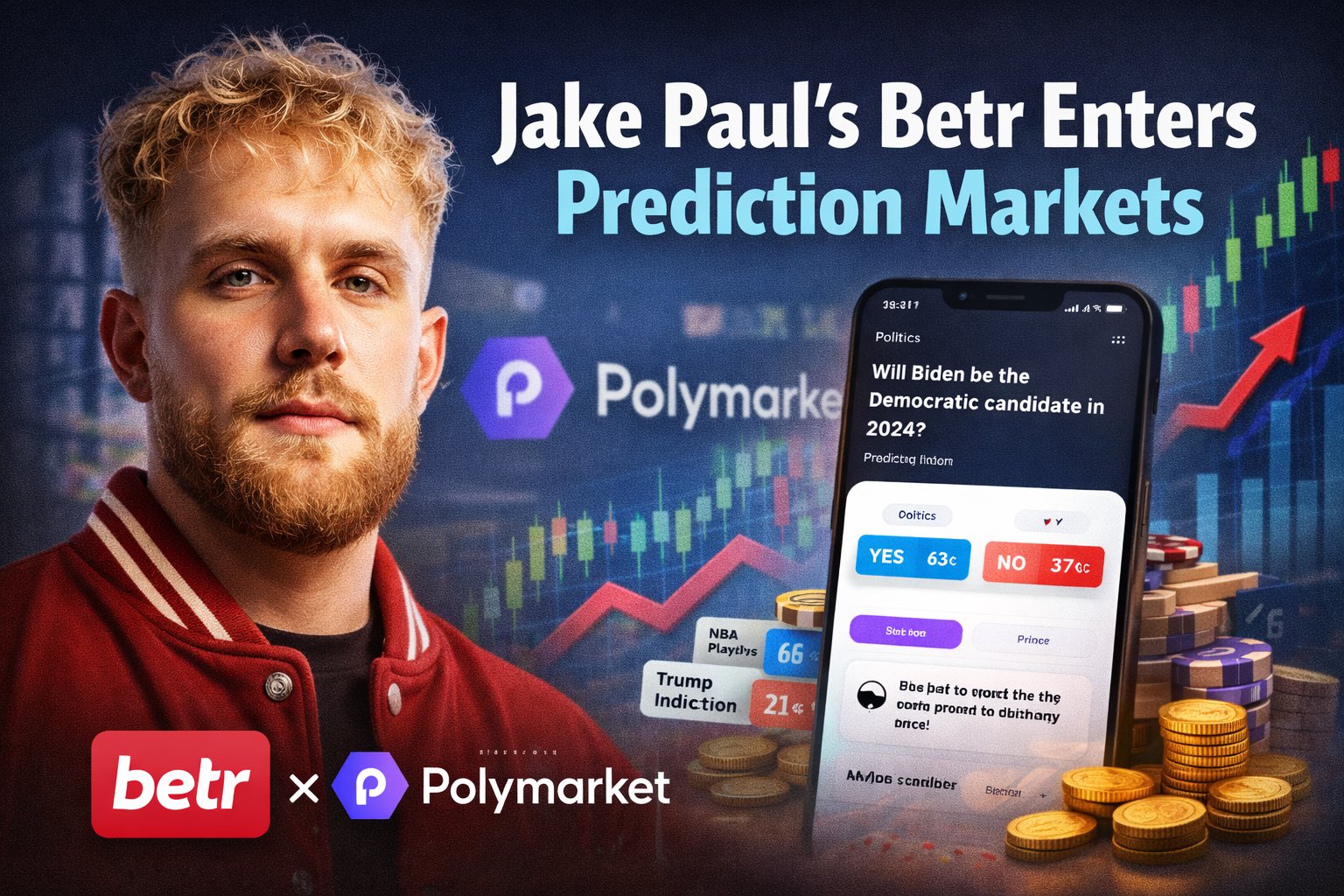
YouTuber Jake Paul’s social entertainment company Betr is launching a prediction market with Polymarket. Betr is a social prediction market that allows users to bet on the outcome of future events in a social environment. They aim to allow users to buy, sell on any future event.
The startup, which was founded by CEO and co-founder Joey Levy, is a gaming company. The company let us know that they’re planning to add Polymarket event contracts to their mobile game this year. Details of the partnership are multi-year but not otherwise disclosed.
Part of the company’s efforts to launch Predictions in its bid to become the first national real-money gaming and financial super app encompassing a $1 trillion dollar category of transactions as well as Picks, Sportsbook, Casino and Arcade. “This is a key step in our mission to create the first national real-money gaming and financial super app,” said Levy in the statement. “There is no better partner to launch Predictions than Polymarket, the leaders in the market and deeply engaged in the sports ecosystem.”
Financial terms of the accord weren’t disclosed.
Prediction Markets Boost Betr Product Portfolio
Betr is a sportsbook headquartered in Miami and has rolled out a number of different products for customers and describes itself as the original super app which may be more than a marketing term.
Betr already has a suite of products that are available across most of Australia, including Betr Picks, Betr Social Sportsbook, Betr Social Casino and Betr Arcade, and has gaming licences nationally. It has also received praise from the ADR for its responsible practices. The prediction markets product will be housed within the main Betr app.
Betr has received regulatory approval to launch sports betting in six states, and has established a comprehensive media division focused on the convergence of sports and betting, via a series of sports and betting focused podcasts.
The company said it has a proven track record in the alternative media space and it believes this will help with its efforts to rebrand and raise awareness of its efforts to reach younger generations, and that it is the world’s largest prediction market operator.

Featured Casino
Ghostino
Sign up bonus
Up to 15% Weekly Cashback
Ghostino Casino is a relatively new casino offering a wide range of Crypto games, attractive bonuses for both new and existing players and a very engaging, user-friendly platform. You can choose from a wide selection of crypto currencies to deposit or use your credit/debit card to buy crypto and fund your account.
Expect Expansion of the Super App Concept
Betr is a leading example of a ‘super app’ for sports betting, and prediction markets could be an innovative way to further advance the model for other companies in the gaming and financial services sectors. The original wagering products are here to stay and will always have a huge following of customers, but incorporating prediction markets into the app could be an exciting way to provide an additional engagement channel.
Active retail traders that have an interest in sports betting or prediction markets are also likely to be interested in trading platforms and event contract exchanges.
Super Apps Make a Splash as Coinbase, DraftKings, Robinhood & More Look to Create One Stop Shop by Matt Krusznis Well-known companies including Coinbase Global Inc., DraftKings Inc., Fidelity National Information Services Inc., Reddit Inc., Robinhood Markets Inc. and Square Inc. are examining the possibility of transforming their applications into so-called “super apps” that allow users to access a number of different services in a single location. Super apps often allow users to send money, order food and pay for other goods and services
Prediction Markets: A Disruption Divided
Ismail Vali, president of Gaming Compliance International, has argued that prediction markets are part of a wave of what he calls “innovator gambling”, platforms that use regulatory gray zones to reach the same sports betting audience through the back door. GCI data, which I reported on in February, showed that the number of licensed online gaming operators in the United States fell from 103 in 2023 to just 57 last year. Nearly half the industry, gone in two years, not through mergers, but through attrition. Prediction market trading volume on the Super Bowl alone hit $3.1 billion this year, up 39% year over year. Yet to Vali, these platforms “look, smell like betting” while operating outside state gaming commissions, regulated instead by the CFTC as financial instruments.
The Prediction Market Deal
Under the partnership, Polymarket will power the prediction market backend while Betr handles distribution, marketing, and the user experience. The prediction market product will live inside the same app as Betr Picks (34 states), Betr Social Sportsbook (32 states), Betr Arcade (38 states), and Betr Social Casino (28 states).
“Launching Predictions is an important step toward our vision of creating the first true nationwide real-money gaming and financial super app,” Levy said, “integrating a category projected to reach $1 trillion in annual volume into the same seamless experience as Picks, Sportsbook, Casino, and Arcade.”
Levy frames prediction markets explicitly as fintech, not just gaming, and points to Betr’s consolidated wallet and KYC system as what separates the super app from a loose collection of products.
The Numbers Behind The Prediction Market Boom
The partnership arrives amid a broader prediction market surge.
Polymarket approached $700 million in championship market trading volume around the Super Bowl. Kalshi’s Super Bowl volume grew fivefold year over year. Crypto.com launched its standalone prediction market app, OG, with over 300 Super Bowl markets and margin trading for event contracts. Robinhood entered event contracts. The pace of institutional entry has no recent parallel in gaming or fintech. Last October, Polymarket secured a $2 billion investment from Intercontinental Exchange, the parent of the New York Stock Exchange.
The 50-state advantage is central to the growth. In Texas, California, and Utah — states that account for roughly a fifth of the U.S. population — prediction markets are the only legal way to put money on a game.
The mainstream pull is visible outside of trading volume too. In early 2026, apps that let retail users copy Polymarket whale traders and Congressional stock picks went viral, with some reaching the top of the App Store. Prediction markets have gone from a niche category to a breakout segment in less than two years.
The Insider Trading Integrity Overhead
The growth comes with baggage. Prediction markets’ most visible vulnerability is insider trading or at least the appearance of it.
In March, fresh wallets made $1.2 million on Polymarket hours before U.S. airstrikes on Iran became public. In December, an alleged insider netted $1 million in 24 hours on the platform. Both episodes prompted Congressional letters from Democratic lawmakers demanding a CFTC investigation.
Levy acknowledged the challenge but framed it as an inevitable byproduct of a new market reaching scale. “There’s going to be edge cases and different things to deal with that maybe haven’t been considered before at scale,” he said. “… It seems like everybody’s pretty focused on being a good actor, operating with integrity, working together to figure out the right set of kind of policies and procedures and integrity frameworks.”
He cited early progress on the sports side, where the NHL and MLS have already built integrity frameworks in partnership with prediction market companies. Betr itself holds gaming licenses nationwide and says it has been commended by regulators for its responsible gaming practices.
What Comes Next
Levy hinted that Betr intends to build “products on top of these prediction markets that the industry has not launched yet or has not seen before.” He declined to elaborate.
Whether prediction markets end up regulated as gambling or remain classified as financial instruments, the distribution race is underway. Coinbase, Crypto.com, Robinhood, and now Betr are all competing to funnel mainstream consumers into event contracts. The platforms that survive will be the ones that make the product frictionless.
‘I made my first trade on Polymarket in 2020. It required bridging assets, connecting a crypto wallet, and navigating an interface that felt closer to a DeFi protocol than a consumer app. Coplan was in my DMs asking me to come back and trade more. Six years later, his prediction market infrastructure will be one tap away inside a regulated super app with a million users and a marketing machine built for Gen Z.’